Planning Poker Template
Estimate the effort of tasks as a team, quickly and without long debates. Everyone reveals their estimate at the same time, so no one is influenced by the first opinion.
Free to start · Swiss-made · GDPR compliant
How to use the Planning Poker template
The Collaboard template has a shared poker table in the center, with six seats around an estimation area, a field for a reference user story, an area for disagreements and a row for the user stories to estimate. Around it, each participant has a personal card area in their own color with a full deck, a coffee cup and a question mark card. The board also includes step-by-step instructions for the moderator and the participants.

Prepare the board
Add the user stories to the overview row, enter the names at the seats and send the board link to the team in advance.
Present a story
The moderator moves the first user story into the estimation area and explains it if needed.
Estimate on your own
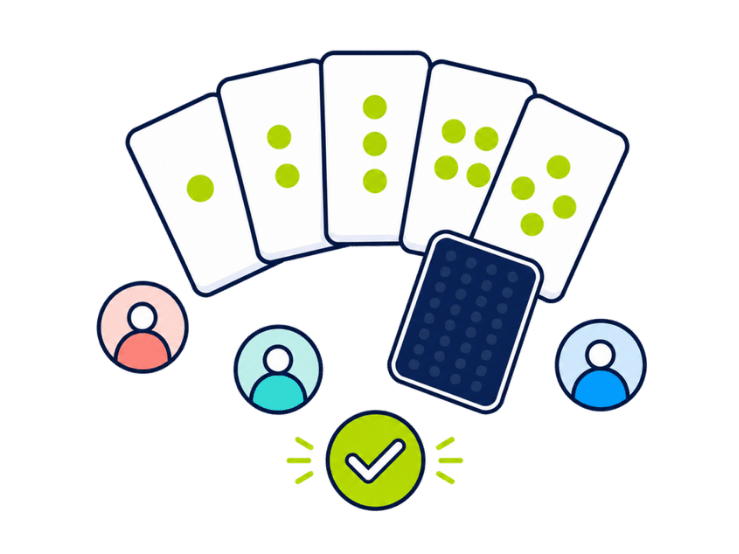
Everyone picks a card from their personal area and places it face down on the table, without discussing.
Reveal together
Turn all cards over at the same time and line them up, so the spread of estimates is visible at a glance.
Discuss the outliers
The people with the highest and lowest estimates explain their reasoning. Then the team agrees on a value or estimates again.
Move on or postpone
Record the estimate and take the next story. If the team can't agree, postpone the story instead of forcing a number.
What is Planning Poker?
Planning Poker, also called Scrum Poker, is an estimation technique used by agile teams. Each team member estimates the effort of a user story with a card, everyone reveals their card at the same time, and the team discusses differences until it agrees. Because nobody sees the other cards in advance, everyone forms their own opinion and the loudest voice doesn't set the number.
What the cards mean
- 1, 2, 3, 5: small tasks Clear and quick to do. Example: changing the text of an error message.
- 8 and 13: medium tasks 13 is about the largest size a team can still finish within one sprint. Example: adding a new filter to a search page.
- 20 and 40: too large for a sprint Split these stories into smaller ones before planning them. Example: a new user role with its own permissions.
- 100: very large Usually an epic that can't be estimated yet. Example: a complete redesign of the checkout.
- Coffee cup Suggests a break.
- Question mark You're unsure, need more information or don't want to estimate yet.
The numbers are story points: they compare the effort of stories with each other, not hours. If you want to sort stories by scope rather than effort, the MoSCoW matrix is a better fit.
When to use this template
- Sprint planning Estimate the user stories for the next sprint as a team.
- Backlog refinement Size new stories before they reach sprint planning.
- Distributed teams Everyone picks a card in their own area, wherever they are.
- Spotting unclear stories A wide spread of estimates shows where a story needs more detail.
Tips for a good session
- Agree on a reference story Place a well-known story in the reference field. Every new estimate is compared to it.
- Define the game rules Agree beforehand how many rounds you play and when a story gets postponed. The board has a field for it.
- Split large stories A 20, 40 or 100 is a signal to break the story down, not a number to plan with.
- Take the question mark seriously If several people play it, the story needs clarification before anyone estimates.
Why Collaboard
A Swiss-made online whiteboard for teams that care where their data lives.
Your data stays in Europe
Choose hosting in Switzerland, Germany or the EU, fully GDPR compliant. Or run Collaboard on your own servers.
Invite anyone with a link
Guests join your board for free, right in the browser. Nothing to install, no extra licenses for participants.
Made in Switzerland, with real support
Collaboard is developed in Switzerland. When you need help, you talk to people who know the product.
Frequently asked questions
Is the Planning Poker template free?
Yes, the Planning Poker template is free to use with a Collaboard account. The free plan includes up to 3 boards and five people per session.
What is Planning Poker?
Planning Poker is an agile estimation technique. Team members estimate tasks with cards, reveal them at the same time and discuss differences until they agree.
What do the numbers in Planning Poker mean?
In Planning Poker, the numbers are story points that compare the effort of stories with each other. In the Collaboard template, 1 to 5 stand for small tasks, 8 and 13 for medium tasks, 20 and 40 for stories too large for one sprint, and 100 for an epic.
What do the coffee cup and question mark cards mean in Planning Poker?
In Planning Poker, the coffee cup card suggests a break. The question mark card shows that someone is unsure, needs more information or doesn't want to estimate yet.
How long does a Planning Poker session take?
A Planning Poker session depends on the number of tasks. As a rule of thumb, plan a few minutes per task and about an hour for a typical sprint planning.
Does Planning Poker work remotely?
Yes, Planning Poker works remotely in Collaboard. Each participant picks a card in their own card area, and the team reveals all estimates on the shared table at the same time.
Start your next whiteboard now
Get a free trial of Collaboard with up to 3 boards and five people per session. All key features are available for you to try out.