Starfish Retrospective Template
Go beyond start, stop and continue. The Starfish Retrospective adds more of and less of, so your team can fine-tune what it already does instead of only deciding what to change.
Free to start · Swiss-made · GDPR compliant
Working through the five arms of a Starfish retrospective
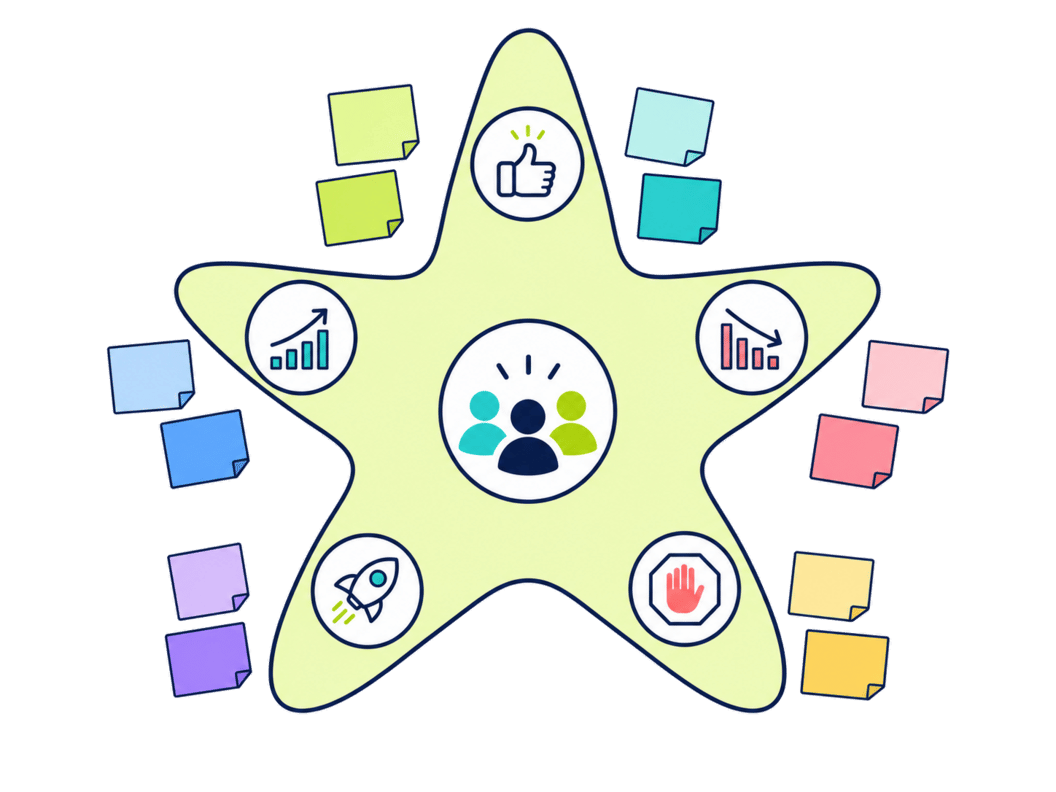
The Collaboard template places a starfish in the center, with its five arms dividing the board into five areas. Each area has its own deck of notes in a matching color: green for Keep Doing, yellow for More Of, red for Start Doing, orange for Stop Doing and blue for Less Of. The board shows at a glance where the team wants to change.

Explain the difference
Clarify at the start that More Of and Less Of are about how much, while Start Doing and Stop Doing are about whether at all.
Write silently
Everyone takes notes from the five decks and adds one idea per note to the matching area.
Walk around the starfish
Go through the arms one by one, read the notes and group similar ones.
Look for contradictions
Notes about the same topic in More Of and Less Of show where the team disagrees. Discuss those first.
Vote
Use dot voting to pick the two or three changes that matter most.
Agree on actions
Turn them into concrete actions with an owner and review them in the next retrospective.
What is a Starfish Retrospective?
The Starfish Retrospective is a retrospective format with five categories arranged like the arms of a starfish: Keep Doing, More Of, Start Doing, Stop Doing and Less Of. Compared to simpler formats, it lets a team express nuance, for example that a practice is useful but takes up too much time.
The five arms of the template
- Keep Doing What works well and should stay as it is. Example: the weekly demo with stakeholders.
- More Of Good practices the team should do more often. Example: code reviews in pairs.
- Start Doing New practices the team wants to try. Example: a written decision log.
- Stop Doing Things that add no value and should end. Example: a recurring meeting nobody needs anymore.
- Less Of Useful things that take too much time or energy. Example: long email threads instead of a quick call.
If five arms feel like too much for your team, Start Stop Continue is the simpler version.
Teams and moments for the Starfish format
- Experienced teams More nuance for teams that know the classic formats well.
- Fine-tuning a process Adjust practices that basically work instead of starting over.
- After a change Reflect a few weeks after introducing a new tool or way of working.
- Quarterly retrospectives Look at a longer period, where more has happened than start and stop can capture.
Using five areas without losing focus
- Keep the arms apart A note in Less Of means keep it, but reduce it. If the team wants to end something completely, it belongs in Stop Doing.
- Plan enough time Five areas take longer than three. Allow 45 to 60 minutes.
- Use contradictions When one person wants more of something and another wants less, that's where the useful conversation starts.
- Pick few actions Choose two or three changes, not one per arm.
Why Collaboard
A Swiss-made online whiteboard for teams that care where their data lives.
Your data stays in Europe
Choose hosting in Switzerland, Germany or the EU, fully GDPR compliant. Or run Collaboard on your own servers.
Invite anyone with a link
Guests join your board for free, right in the browser. Nothing to install, no extra licenses for participants.
Made in Switzerland, with real support
Collaboard is developed in Switzerland. When you need help, you talk to people who know the product.
Frequently asked questions
Is the Starfish Retrospective template free?
Yes, the Starfish Retrospective template is free to use with a Collaboard account. The free plan includes up to 3 boards and five people per session.
What are the five categories of the Starfish Retrospective?
The Starfish Retrospective uses five categories: Keep Doing, More Of, Start Doing, Stop Doing and Less Of.
What is the difference between Starfish and Start Stop Continue?
The Starfish Retrospective adds More Of and Less Of to Start Stop Continue. That lets teams adjust how much they do something, not only whether they do it.
How long does a Starfish Retrospective take?
A Starfish Retrospective takes 45 to 60 minutes for a team of five to eight people, including discussion and agreeing on actions.
Can I run a Starfish Retrospective with a remote team?
Yes, a Starfish Retrospective works with remote teams. Everyone works on the same Collaboard board in real time, so the format runs the same way online.
Start your next whiteboard now
Get a free trial of Collaboard with up to 3 boards and five people per session. All key features are available for you to try out.