Concept Map Template
Show how ideas and concepts relate to each other. A concept map connects terms with labeled lines, making complex topics easier to understand and explain.
Free to start · Swiss-made · GDPR compliant
Building a concept map with labeled connections
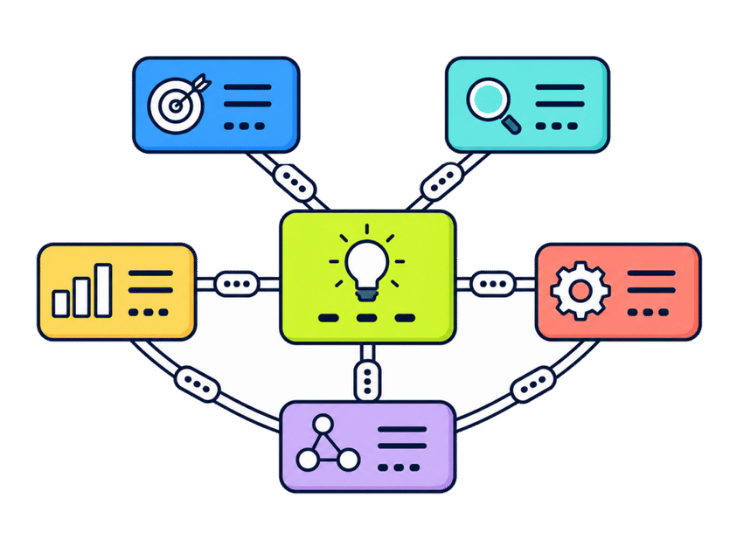
The Collaboard template places the central concept in the middle, with branches to both sides. Each branch has its own color, from yellow and orange to red, pink and blue, and leads to further boxes at the outer level. All boxes and lines can be moved, copied and extended as the map grows.

Name the central concept
Replace Concept Map in the center with your topic.
Add the main branches
Write the most important related concepts in the boxes next to the center.
Add details
Fill the outer boxes with concepts that belong to each branch.
Label the connections
Add a short word on the lines, such as causes, includes or needs, so the relationships are clear.
Connect across branches
Draw extra lines where concepts from different branches relate to each other.
Review and simplify
Check whether every box is needed and whether the map still reads at a glance.
What is a concept map?
A concept map shows how ideas or terms relate to each other. A central concept sits in the middle, with related concepts branching out and further details at the edges. Labeled connections explain how the concepts are linked, which makes concept maps useful for learning, explaining complex topics and structuring knowledge.
The levels of the template
The examples follow one illustrative scenario: a team mapping the topic of remote work.
- Central concept The main topic in the middle. Example: remote work.
- Main branches The key areas connected to it. Example: tools, communication and wellbeing.
- Details Further concepts at the outer level. Example: video calls, chat and digital whiteboards under tools.
If you want to show a sequence of steps rather than relationships, use a flowchart.
Concept maps for learning and knowledge sharing
- Learning Structure a new topic and see how its parts fit together.
- Explaining complex topics Show stakeholders how different factors relate.
- Knowledge management Capture what a team knows about a system or process.
- Content planning Plan articles or training modules around one central topic.
Why labeled lines make the difference
- Use short terms One to three words per box keep the map readable.
- Give each branch a color Colors show at a glance which concepts belong together.
- Label the lines A word on the connection turns a list of terms into real knowledge.
- Build it together Different people see different connections, and that's where the value lies.
Why Collaboard
A Swiss-made online whiteboard for teams that care where their data lives.
Your data stays in Europe
Choose hosting in Switzerland, Germany or the EU, fully GDPR compliant. Or run Collaboard on your own servers.
Invite anyone with a link
Guests join your board for free, right in the browser. Nothing to install, no extra licenses for participants.
Made in Switzerland, with real support
Collaboard is developed in Switzerland. When you need help, you talk to people who know the product.
Frequently asked questions
Is the concept map template free?
Yes, the concept map template is free to use with a Collaboard account. The free plan includes up to 3 boards and five people per session.
What is a concept map used for?
A concept map shows how concepts relate to each other, for example in teaching, research or knowledge management.
Who invented the concept map?
The concept map was developed by Joseph Novak in the 1970s.
What is the difference between a concept map and a mind map?
A mind map grows from one central topic. A concept map connects many concepts and labels each connection.
Can students work on a concept map together?
Yes, students can work on the same concept map in Collaboard in real time, which makes it well suited for group work in class.
Start your next whiteboard now
Get a free trial of Collaboard with up to 3 boards and five people per session. All key features are available for you to try out.