Persona Template
Describe a typical customer based on research and real data. The persona template gives marketing, sales and product one shared picture of who you're selling to and how you can help.
Free to start · Swiss-made · GDPR compliant

Creating a persona for your target group
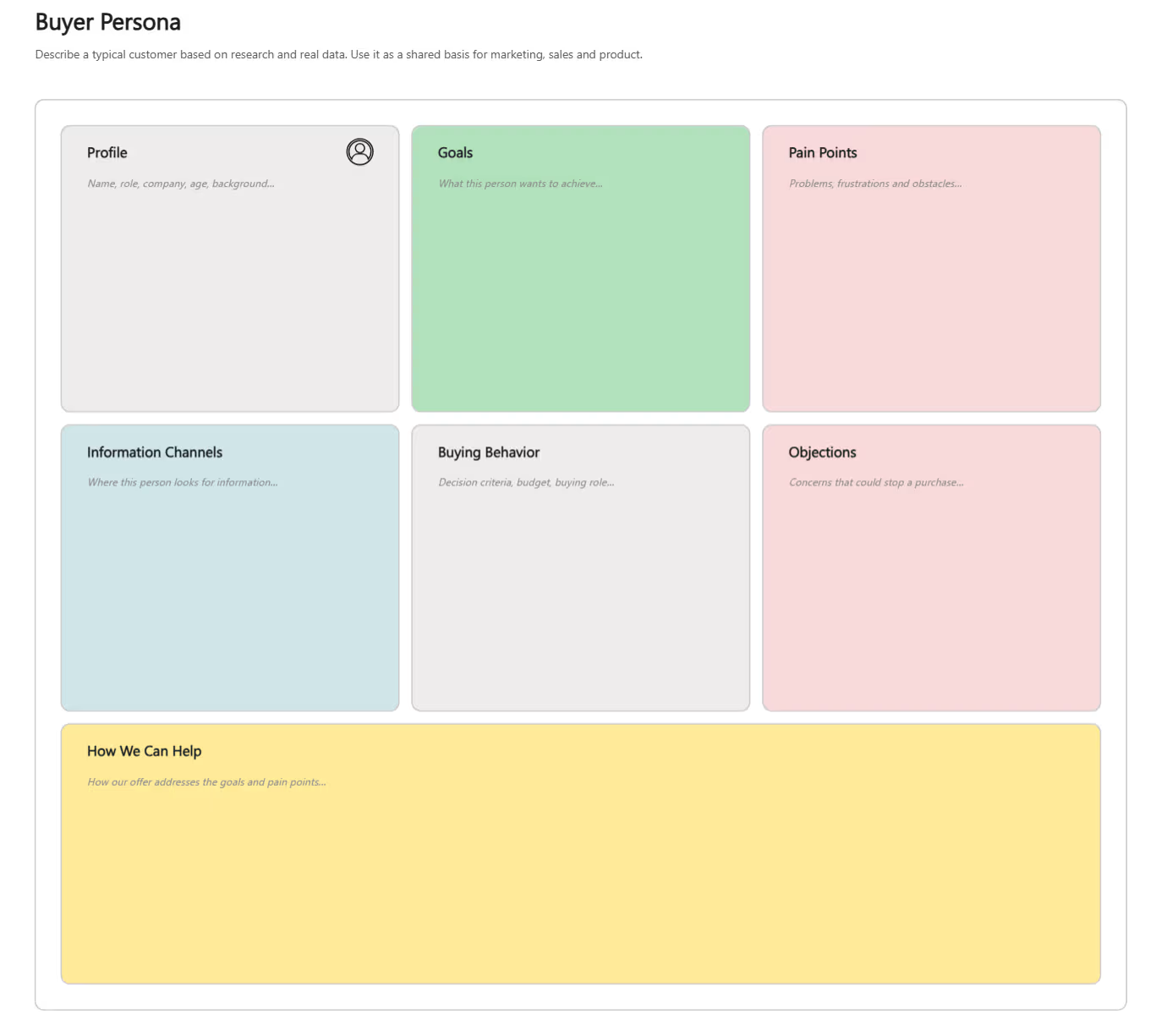
The Collaboard template has seven colored fields on one board, each with a short guiding question: profile, goals and pain points at the top, information channels, buying behavior and objections in the middle, and a wide field at the bottom for how you can help. The board leads from the customer's situation to your answer.
Gather research
Collect interviews, sales notes and customer data about the target group before you start.
Fill in the profile
Give the persona a name, a role and a company, and add the background that matters for buying.
Add goals and pain points
Describe what the persona wants to achieve and what stands in the way.
Describe how they buy
Note where they look for information, how they decide and who else is involved.
Collect objections
Write down the concerns that could stop a purchase. Sales usually knows them best.
Show how you help
In the bottom field, link your offer to the goals and pain points above, and check that every objection has an answer.
What is a persona?
A persona, often called a buyer persona in marketing and sales, is a fictional but realistic profile of a typical customer. It gives a target group a face and shows what this person wants, what gets in their way and how they decide to buy. Good personas are based on interviews, sales conversations and real data, not just assumptions.
The seven fields of the template
The examples follow one illustrative persona: Laura, 38, HR manager at a mid-sized company, looking for a new tool for employee training.
- Profile Name, role, company, age and background. Example: Laura, HR manager, 250 employees, eight years in HR.
- Goals What this person wants to achieve. Example: train new employees faster and with less effort.
- Pain Points Problems, frustrations and obstacles. Example: training material spread across many files and tools.
- Information Channels Where this person looks for information. Example: LinkedIn, HR newsletters and recommendations from peers.
- Buying Behavior Decision criteria, budget and buying role. Example: decides together with IT and needs approval for anything above budget.
- Objections Concerns that could stop a purchase. Example: worries about data protection and the time needed to set it up.
- How We Can Help How your offer addresses the goals and pain points. Example: ready-made training templates, a quick setup and clear answers on data protection.
If you want to focus on what customers are trying to achieve rather than who they are, Jobs to be Done is a good complement.
How marketing, sales and product use personas
- Marketing Write messages and content for a real person instead of a broad audience.
- Sales Prepare for conversations and objections before the first call.
- Product development Make feature decisions from the customer's perspective.
- Onboarding Show new team members quickly who the customers are.
Making a persona realistic instead of assumed
- Base it on research A persona made only of assumptions confirms what the team already believes.
- Involve sales Sales teams hear objections and buying criteria every day. Their input makes the persona realistic.
- Be specific Details like tools, habits and typical quotes make a persona come alive. Generic descriptions don't help decisions.
- Keep the number small Three to five personas are usually enough. More become hard to use.
Why Collaboard
A Swiss-made online whiteboard for teams that care where their data lives.
Your data stays in Europe
Choose hosting in Switzerland, Germany or the EU, fully GDPR compliant. Or run Collaboard on your own servers.
Invite anyone with a link
Guests join your board for free, right in the browser. Nothing to install, no extra licenses for participants.
Made in Switzerland, with real support
Collaboard is developed in Switzerland. When you need help, you talk to people who know the product.
Frequently asked questions
Is the persona template free?
Yes, the persona template is free to use with a Collaboard account. The free plan includes up to 3 boards and five people per session.
What is a buyer persona used for?
A buyer persona gives marketing, sales and product a shared picture of a typical customer, so messages, sales conversations and product decisions point in the same direction.
How many personas do I need?
Most teams need three to five personas, each representing a clearly different user group.
Should personas be based on research?
Yes, personas should be based on interviews, sales conversations and customer data. Personas based only on assumptions can lead to wrong decisions.
Can I create personas together with my team?
Yes, personas can be created as a team in Collaboard. Everyone works on the same board in real time, which helps the team agree on a shared picture of its users.
What is the difference between a persona and a buyer persona?
A buyer persona is a persona focused on buying decisions. Besides goals and pain points, it covers information channels, buying behavior and objections.
Start your next whiteboard now
Get a free trial of Collaboard with up to 3 boards and five people per session. All key features are available for you to try out.