SWOT Analysis Template
Look at strengths, weaknesses, opportunities and threats on one board. The SWOT analysis gives you a clear picture of where you stand before you make a strategic decision.
Free to start · Swiss-made · GDPR compliant
Doing a SWOT analysis in six steps
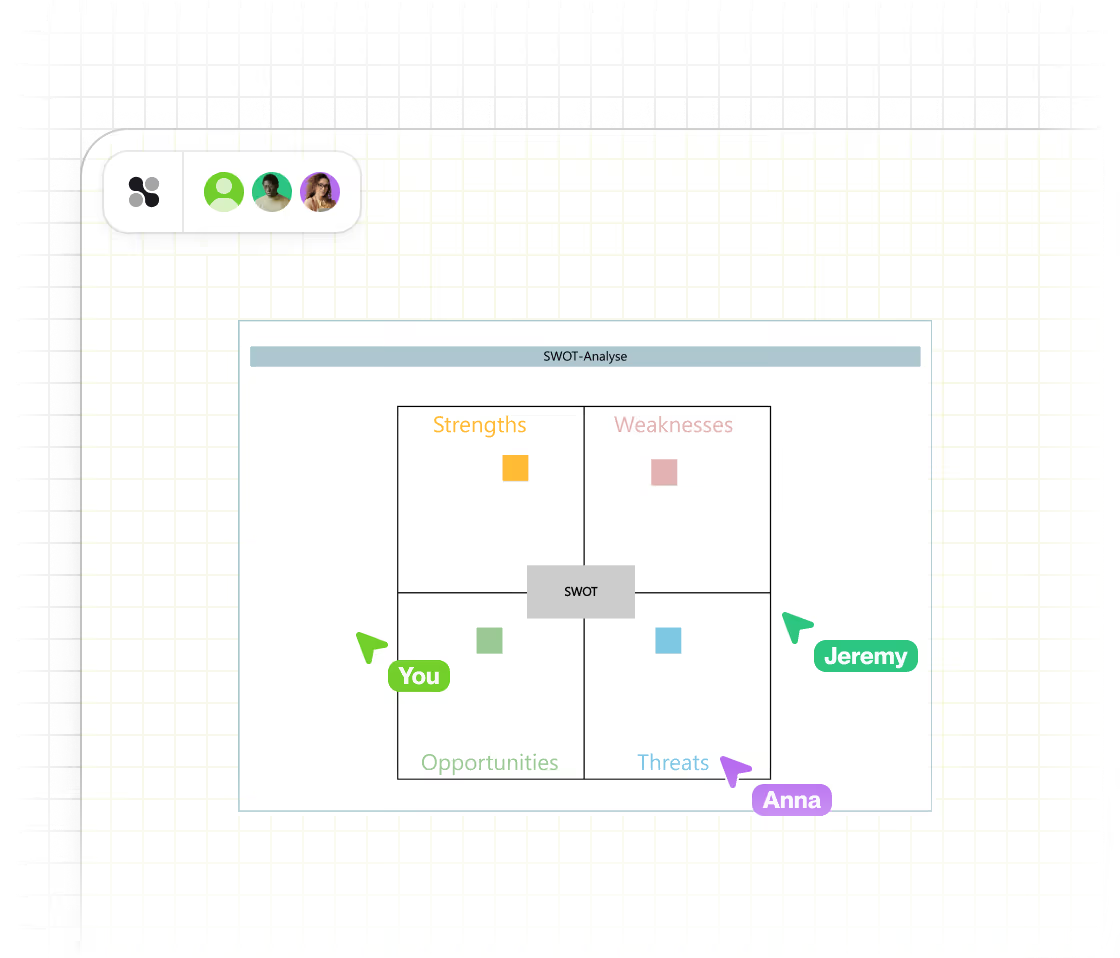
The Collaboard template is a clear 2x2 grid with color-coded headings: orange for Strengths, pink for Weaknesses, green for Opportunities and blue for Threats. The upper row covers internal factors, the lower row external ones. Teams add sticky notes to each quadrant and move them around as the discussion develops.

Define the subject
Agree on what you're analyzing and why, for example a product launch or a market entry. Write it in the center of the grid.
Collect strengths and weaknesses
Everyone adds internal factors on notes: what the organization does well and where it falls short.
Collect opportunities and threats
Add external factors: trends, competitors, regulation or customer behavior that the organization can't control.
Check the sorting
Make sure each note is in the right row. Internal means you can influence it, external means you can only react to it.
Combine the quadrants
Ask how strengths can use opportunities, and how weaknesses could make threats worse. This is where strategies come from.
Agree on actions
Turn the most important combinations into concrete actions with an owner.
What is a SWOT analysis?
A SWOT analysis looks at a company, product, project or person from four angles: internal strengths and weaknesses, and external opportunities and threats. The overview helps to make strategic decisions on a solid basis.
The four quadrants of the template
The examples follow one illustrative scenario: a regional bakery chain deciding whether to launch online ordering.
- Strengths (internal) What we do well. Example: loyal regular customers and a strong local brand.
- Weaknesses (internal) Where we fall short. Example: no experience with e-commerce.
- Opportunities (external) Developments we can use. Example: growing demand for ordering ahead.
- Threats (external) Developments that could hurt us. Example: delivery platforms with large marketing budgets.
To look at external factors in more depth first, start with a PESTEL analysis and carry the results over into opportunities and threats.
Typical reasons to run a SWOT analysis
- Strategy workshops Create a shared picture before the team decides on a direction.
- Market entry or product launch Check whether a new move fits the organization.
- Project start Name strengths, risks and dependencies before work begins.
- Career planning Look at your own strengths and opportunities before the next step.
Keeping internal and external factors apart
- Keep internal and external apart The most common mistake is listing a market trend as a strength. If you can't influence it, it belongs in the lower row.
- Be specific Good team is not a strength. Ten years of experience in retail software is.
- Don't stop at the four lists The value lies in combining them into actions, not in the lists themselves.
- Bring in other views Ask customers or colleagues from other departments. Weaknesses are often easier to see from outside.
Why Collaboard
A Swiss-made online whiteboard for teams that care where their data lives.
Your data stays in Europe
Choose hosting in Switzerland, Germany or the EU, fully GDPR compliant. Or run Collaboard on your own servers.
Invite anyone with a link
Guests join your board for free, right in the browser. Nothing to install, no extra licenses for participants.
Made in Switzerland, with real support
Collaboard is developed in Switzerland. When you need help, you talk to people who know the product.
Frequently asked questions
Is the SWOT analysis template free?
Yes, the SWOT analysis template is free to use with a Collaboard account. The free plan includes up to 3 boards and five people per session.
What is a SWOT analysis used for?
A SWOT analysis gives a clear overview of internal strengths and weaknesses and external opportunities and threats before strategic decisions, for example for a company, a product, a project or your own career.
Who is a SWOT analysis suitable for?
A SWOT analysis suits business leaders, marketing teams, start-ups and individuals who want to make strategic decisions or plan their careers.
Can I use the SWOT template in team meetings?
Yes, the SWOT template works well in team meetings. Everyone works on the same board in real time, which makes it easy to collect and discuss different perspectives.
Can a SWOT analysis be used for personal development?
Yes, a SWOT analysis also works for personal development. Look at your own strengths and weaknesses and at the opportunities and threats around you to plan your next career step.
Can I edit the SWOT template?
Yes, the SWOT template can be edited. You can add fields, color-code points, add notes and images, and update the analysis at any time.
Start your next whiteboard now
Get a free trial of Collaboard with up to 3 boards and five people per session. All key features are available for you to try out.