Reverse Brainstorming Template
Instead of asking how to solve a problem, ask how to make it worse. Reverse brainstorming turns those answers into new solutions and helps teams break out of familiar thinking.
Free to start · Swiss-made · GDPR compliant
Running a reverse brainstorming session
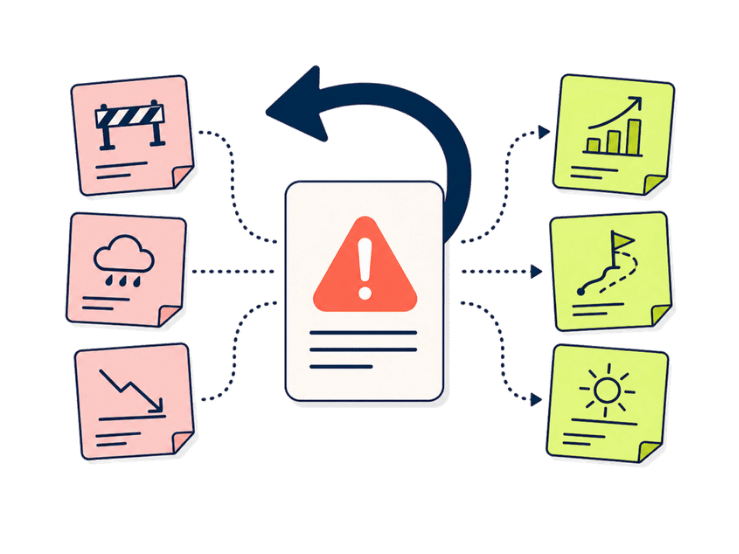
The Collaboard template has three columns: orange for defining the problem, blue-grey for collecting ideas and green for identifying solutions. The first two columns are split into a collect half and a reverse half, linked by a circle of arrows, so the board shows each turn of the method. A deck with notes in all three colors sits on the left.

Define the problem
Write the problem in the top half of the orange column, as specifically as possible.
Reverse it
In the bottom half, turn it around: how could we cause this problem or make it worse?
Collect bad ideas
Everyone writes ideas for the reversed problem on blue-grey notes. The more absurd, the better.
Turn the ideas around
For each idea, write its opposite in the bottom half of the blue-grey column.
Identify solutions
Move the reversed ideas worth pursuing into the green column.
Prioritize
Vote on the solutions and agree on which ones to try first.
What is reverse brainstorming?
Reverse brainstorming turns a problem around. Instead of asking how to solve it, the team asks how to cause it or make it worse. Those ideas are usually easier to find, and turning them back around reveals solutions the team might not have seen otherwise.
The three columns of the template
The examples follow one illustrative scenario: a team that wants more people to attend its internal training sessions.
- Define the problem Write down the problem, then reverse it. Example: few people attend our training sessions, reversed: how could we make sure nobody attends?
- Collect ideas Collect ideas for the reversed problem, then turn each one around. Example: schedule sessions on Friday afternoons, reversed: schedule them when people have time.
- Identify solutions Collect the reversed ideas worth pursuing. Example: offer short sessions right after the weekly team meeting.
If the team isn't stuck and simply needs many ideas, a classic brainstorming is quicker.
Where reverse brainstorming helps
- Stuck teams Break a deadlock when a normal brainstorming keeps producing the same ideas.
- Service and process improvement Find out what makes an experience bad, then avoid it.
- Risk thinking Ask how a project could fail, then prevent it.
- Loosening up a workshop Thinking up bad ideas is fun and lowers the barrier to contribute.
Getting real solutions out of bad ideas
- Make the problem specific How to make customers unhappy is too broad. How to make customers wait as long as possible on the phone works better.
- Allow absurd ideas Exaggerated ideas often point to the most useful solutions.
- Reverse every idea Don't skip the step back. That's where the actual solutions come from.
- Check the obvious Some bad ideas describe what's already happening. Those are the first things to fix.
Why Collaboard
A Swiss-made online whiteboard for teams that care where their data lives.
Your data stays in Europe
Choose hosting in Switzerland, Germany or the EU, fully GDPR compliant. Or run Collaboard on your own servers.
Invite anyone with a link
Guests join your board for free, right in the browser. Nothing to install, no extra licenses for participants.
Made in Switzerland, with real support
Collaboard is developed in Switzerland. When you need help, you talk to people who know the product.
Frequently asked questions
Is the reverse brainstorming template free?
Yes, the reverse brainstorming template is free to use with a Collaboard account. The free plan includes up to 3 boards and five people per session.
What is reverse brainstorming?
Reverse brainstorming is a creativity technique in which a team collects ways to cause or worsen a problem, then turns those ideas around into solutions.
When should I use reverse brainstorming?
Reverse brainstorming helps when a team is stuck, keeps repeating the same ideas, or wants to look at a problem from a new angle.
How is reverse brainstorming different from classic brainstorming?
Classic brainstorming looks for solutions directly. Reverse brainstorming starts with the problem, which often makes it easier to get going.
Can I combine reverse brainstorming with other methods?
Yes, the ideas from a reverse brainstorming can be prioritized afterwards, for example with an effort-impact matrix.
Start your next whiteboard now
Get a free trial of Collaboard with up to 3 boards and five people per session. All key features are available for you to try out.