OKR Template
Set ambitious objectives and make progress measurable with key results. The OKR template helps your team agree on what matters most for the next quarter.
Free to start · Swiss-made · GDPR compliant
Holding an OKR workshop with your team
The Collaboard template covers a complete OKR workshop for 6 to 12 participants. Eleven numbered stages lead from the title page and an icebreaker to goals, challenges, voting and group work, with suggested times for each step. The group areas include the OKR formula and a SMART checklist, and the template ends with a next steps table and a meeting template for your first OKR check-in.

Prepare and open
Add your team name to the title page, share the board link in advance and start with the icebreaker.
Collect goals and topics
Everyone adds the goals and topics that matter for the coming period, and the team looks at the OKR cycle together.
Name the obstacles
Collect challenges, tensions and obstacles. If your goals are already set, skip this step and the voting.
Cluster and vote
Group the topics into clusters and vote on the three that matter most.
Co-create the OKRs
Split into groups, one per top topic. Each group writes one objective with its key results, using the formula, and checks them against SMART.
Plan next steps
Note risks, unknowns and next steps for each objective, then use the meeting template for regular check-ins.
What are OKRs?
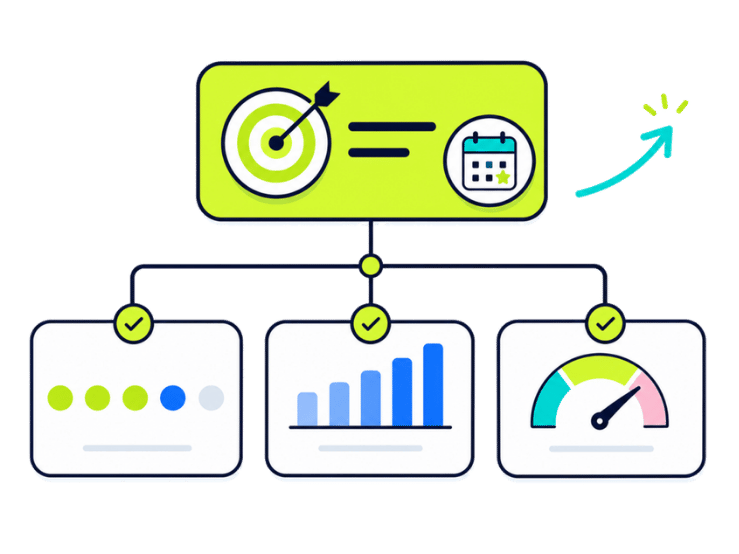
OKR stands for Objectives and Key Results. An objective describes a qualitative goal, and two to five key results make progress toward it measurable. Teams usually set OKRs per quarter and review them regularly. A simple formula helps: I will achieve (objective) as measured by (key results).
The three parts of the template
- OKR workshop A guided session from icebreaker to group work: collect goals and topics, discuss challenges and obstacles, then cluster and vote on the most important topics.
- Group work One area per group with the OKR formula, fields for the objective and the key results, and a SMART checklist. Example: make our website the main source of new customers, measured by 100,000 visitors by August.
- Next steps and OKR meeting A table with risks, unknowns and next steps for each objective, and a meeting template to track progress, confidence and learnings.
If you first need to clarify the purpose behind your goals, start with the Golden Circle.
From quarterly planning to OKR check-ins
- Quarterly planning Set the OKRs for the next quarter together with the team.
- Introducing OKRs Run a first OKR workshop with a team that has never worked with OKRs.
- Aligning departments Bring several teams to shared objectives.
- OKR check-ins Track progress, confidence and learnings with the meeting template.
Few OKRs, qualitative objectives, measurable outcomes
- Limit the number of OKRs The board recommends no more than three OKRs per team or company, so the team stays focused.
- Keep objectives qualitative Numbers belong in the key results. The objective says where you want to go.
- Measure outcomes, not activities 100,000 website visitors is a key result. Publishing ten blog posts is a task.
- Track confidence, not just progress The meeting template asks for a confidence level in percent. A falling value is an early warning.
Why Collaboard
A Swiss-made online whiteboard for teams that care where their data lives.
Your data stays in Europe
Choose hosting in Switzerland, Germany or the EU, fully GDPR compliant. Or run Collaboard on your own servers.
Invite anyone with a link
Guests join your board for free, right in the browser. Nothing to install, no extra licenses for participants.
Made in Switzerland, with real support
Collaboard is developed in Switzerland. When you need help, you talk to people who know the product.
Frequently asked questions
Is the OKR template free?
Yes, the OKR template is free to use with a Collaboard account. The free plan includes up to 3 boards and five people per session.
What does OKR stand for?
OKR stands for Objectives and Key Results. An objective describes a qualitative goal, and key results make the progress toward it measurable.
How many key results should an OKR objective have?
An OKR objective usually has two to five key results. Fewer key results keep the focus clear.
How often are OKRs set?
Most organizations set OKRs per quarter and review them at the end of the quarter, with regular check-ins in between.
What is the difference between OKRs and KPIs?
KPIs measure the ongoing health of a business. OKRs define what should change within a set period and are usually more ambitious.
How many people can take part in an OKR workshop with the template?
The OKR template is designed for 6 to 12 participants. During the co-creation phase, they work in small groups, one per prioritized topic.
Start your next whiteboard now
Get a free trial of Collaboard with up to 3 boards and five people per session. All key features are available for you to try out.