Ansoff Matrix: Definition, Strategies, Examples and Template for Your Growth
Do you want to plan growth, but not justcollect ideas and hope something will fit? Then the Ansoff Matrix can help. Itorganizes your options by products and markets, makes risks visible and showswhich growth paths are closer to your team than others.


.png)

Ansoff Matrix: The most important points in brief
- The Ansoff Matrix organizesgrowth by products and markets: you check whether you want to grow withexisting or new products in existing or new markets.
- The product-market matrixaccording to Ansoff consists of four strategies: market penetration, marketdevelopment, product development and diversification show four paths forgrowth.
- With the Ansoff Matrix, you cancompare opportunities and risks: your team sees which ideas can be testedquickly and which require more data, budget or alignment.
- With the free Ansoff Matrixtemplate from Collaboard, you can start directly in the online whiteboard: yourteam can collect ideas, evaluate them and derive concrete tasks from them.
What is the Ansoff Matrix?
Definition:The Ansoff Matrix is a model that helps you plan growth paths for yourbusiness, a product or a project. It is also called the product-market matrixbecause it connects two questions: What do you offer, and who are youaddressing with it?
The model was developed by Igor Ansoff.Teams still use the matrix today to organize ideas for growth and compare themmore effectively. The reason is simple: the Ansoff Matrix makes it visiblewhether you want to keep growing with existing products or need new products.At the same time, it shows whether you stay in familiar markets or want toenter new markets.
You mainly use the Ansoff Matrix when youwant to examine several growth paths. Instead of collecting individual ideasloosely, you sort them into a clear structure. This helps you see more quicklywhich direction is closer to your current business and which direction involveshigher risks.
Typical questions include:
- How can we continue to growwith existing products?
- Which new markets are relevantfor us?
- Which new products could fitour current market?
- Which growth paths bring highopportunities, but also high risks?
The matrix does not make the decision foryou. But it helps you make options visible, test assumptions and structurediscussions within the team.
How is the product-market matrix according to Ansoffstructured?
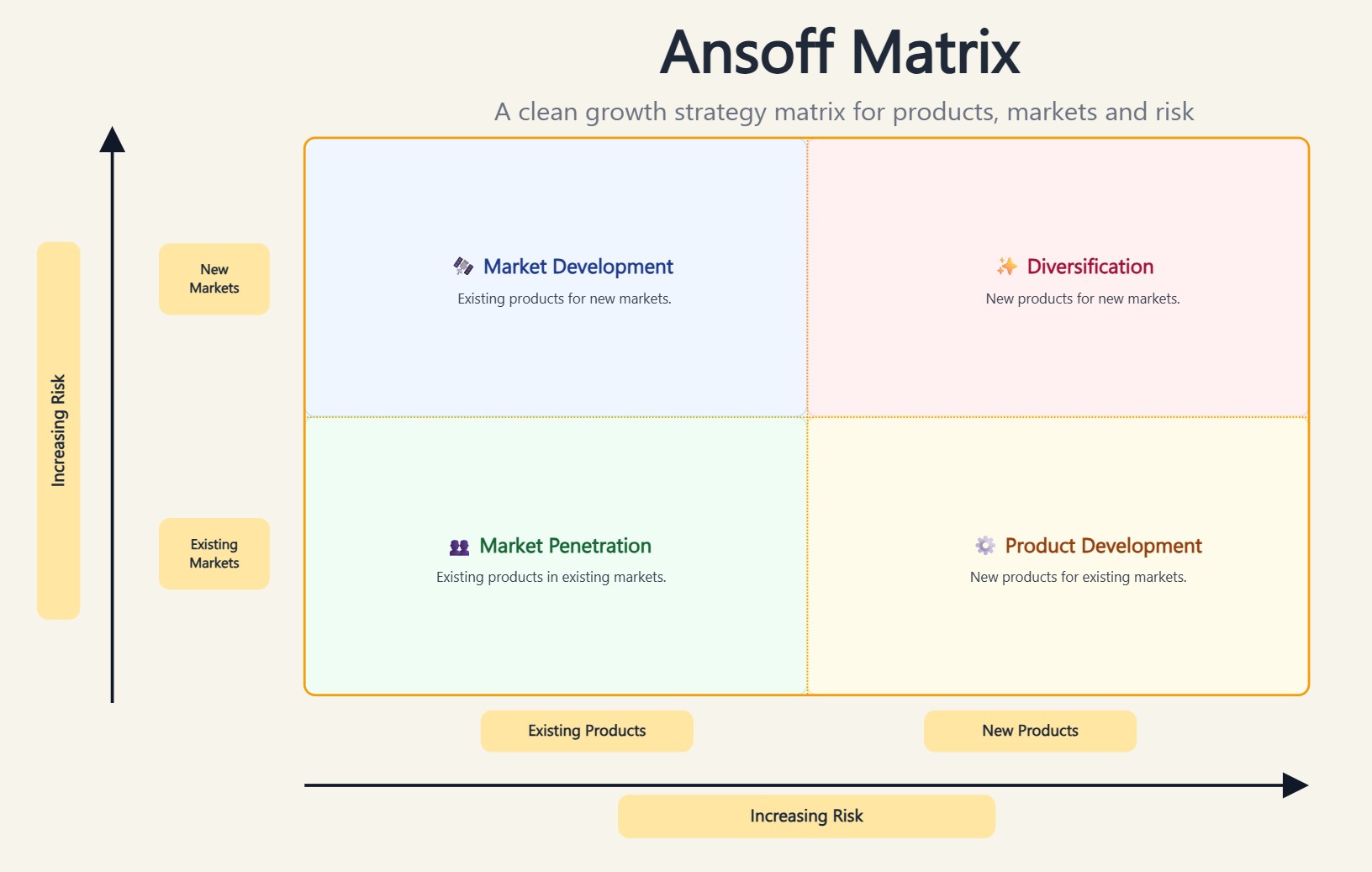
The product-market matrix according toAnsoff consists of two axes. One axis looks at products, the other axis looksat markets. Both axes distinguish between “existing” and “new”. Thiscombination creates four fields.
The following table shows the basicstructure:
The matrix therefore shows a rough risklogic: the further you move away from known products and known markets, themore carefully you should check which data, resources and responsibilities yourteam needs.
Market penetration is in the field ofexisting product and existing market. Here you stay close to the currentbusiness. That is why this field is usually considered lower risk than theother fields.
Market development means: you use anexisting product, but address a new market. This can be a new region, a newtarget group or a new sales channel.
Product development means: you remain inthe existing market, but offer a new product or a new variant there. Youalready know the market, but you have to check whether the new offer reallyfits.
Diversification is in the field of newproduct and new market. Here you change both sides at the same time. That iswhy this field usually involves the highest risk.
Which Ansoff Matrix strategies are there?
The Ansoff Matrix distinguishes fourstrategies for growth. The difference lies in how far your team moves away fromthe familiar business. If you work with familiar products in familiar markets,the risk usually remains manageable. If you change both product and market atthe same time, your team needs significantly more validation, planning andalignment.
Remember:The closer product and market are to today’s business, the better your team canassess opportunities and risks. The newer product and market are, the moreassumptions you should test.
Market penetration: Selling existing products morestrongly in the existing market
With market penetration, you use a productthat already exists in a market your team knows. The goal is to achieve morerevenue, more usage or a higher market share with the existing offer. Thisstrategy fits when your product has already been launched, but there is stillpotential in the current market.
Typical paths are:
- Strengthen customer loyalty:you ensure that existing customers buy more often, stay longer or use more.
- Increase visibility: you makeyour offer more present in the familiar market, for example through campaigns,sales or partners.
- Review prices and packages: youtest new pricing tiers, package sizes or add-on offers.
- Increase usage: you showexisting customers how they can use your product more broadly in everyday work.
The advantage lies in the small distancefrom today’s business. Your team usually already knows the target group, buyingreasons, objections and sales process well. The risk is more that the marketmay eventually be exhausted.
Market development: Entering new markets with existingproducts
With market development, the product staysthe same. What is new is the market your team wants to reach. This can be a newregion, a new industry, a new target group or a new sales channel. Thisstrategy fits when your product works in the current market and can alsoprovide clear value to additional groups.
Typical paths are:
- New regions: you bring anexisting product to additional countries, states or cities.
- New industries: you checkwhether a product from the education sector also fits public authorities, banksor administration.
- New target groups: you addressan existing offer to people or teams with similar tasks.
- New channels: you use partners,platforms or new sales channels.
The opportunity is that your team does nothave to develop a new product. The risk lies in the new market. Differentbuying processes, stricter rules, longer approvals or new competitors may bewaiting there. That is why you should check in advance how the market buys andwhich barriers exist.
Product development: Creating new products for existingmarkets
With product development, your team staysin the familiar market. What is new is the product, the variant, the package orthe complementary service. This strategy fits when your existing target groupexpresses new wishes or when your team recognizes that an additional offerincreases the value.
Typical paths are:
- New features: you add functionsto an existing product that your target group frequently requests.
- New variants: you create anoffer for a clear purpose, such as workshops, planning or training.
- New packages: you bundleexisting services differently so they fit typical workflows better.
- New services: you addconsulting, support, training or templates.
Theadvantage: Your team already knows the market, buying reasons and manyobjections. Nevertheless, this strategy requires clear resources. Development,testing, launch and support take time. Your team should also check whether thenew offer really fits the existing market and does not just sound goodinternally.
Diversification: Placing new products in new markets
With diversification, your team combines anew product with a new market. This makes this strategy the furthest away fromtoday’s business. It can open up new opportunities, but it requires the mostthorough validation. Your team knows neither the product nor the market as wellas with the other strategies.
There are three forms:
- Horizontal diversification: thenew product is close to the existing offer. Your team uses existing knowledge,but addresses a new market.
- Vertical diversification: yourteam takes over steps before or after the existing business, for example sales,procurement or production.
- Lateral diversification: thenew product has hardly any connection to the existing offer. Here the risk isusually the highest.
Diversification can make sense whenexisting growth paths are limited or when a new business area is to be created.Before making the decision, however, your team should clarify which marketknowledge is missing, which investments are needed and which risks remainacceptable.
How do you create an Ansoff Matrix step by step?
With the free Ansoff Matrix template fromCollaboard, you can start directly with a prepared structure. The four fieldsare already set up. Your team can collect ideas, sort them, comment on them,evaluate them and transfer them into concrete tasks.
Tip: Start directly with atemplateOpen the free Ansoff Matrix template in Collaboard, invite your team andcollect all ideas first. Evaluate them only afterwards so that you do not sortout good thoughts too early.
Step 1: Clarify the starting point
Before your team collects ideas, you need ashared understanding of the current situation. First clarify which products,services, markets, target groups and goals are currently relevant. Thisprevents the matrix from being based on assumptions that not everyone in theteam shares.
These points belong in the preparation:
- Current products: Whichproducts, packages, services or offerings do you provide today?
- Current markets: Which targetgroups, industries, regions and sales channels do you already use?
- Goals: Do you want to increaserevenue, expand market share, reach new target groups or evaluate a newbusiness area?
- Knowledge base: Which figuresfrom sales, marketing, product team or customer feedback help with theevaluation?
- Open questions: Where are data,assessments or feedback still missing?
In Collaboard, you can collect these pointson moderation cards. Add tables, comments or documents directly on the board sothat everyone involved sees the same status.
Step 2: Collect ideas for all four fields
After the preparation, your team fills thefour fields of the Ansoff Matrix. In this step, the first priority is breadth.Every idea gets a place, even if it has not yet been fully validated. Theevaluation comes later.
These guiding questions help withcollection:
In Collaboard, use one moderation card peridea. This keeps every option clearly visible. You can group similar cards.Through comments, your team can add follow-up questions without interruptingthe workflow. Important: collect first, then sort, then evaluate.
Step 3: Evaluate opportunities and risks
When all ideas are visible, your teamevaluates them based on fixed criteria. This prevents only the loudest opinionsfrom counting. Every idea should be evaluated against the same points. Thishelps you see more quickly which options are realistic and which need morepreparation.
These evaluation points are suitable:
- Benefit: What contribution canthe idea make to growth, revenue or market position?
- Effort: What time, budget andpeople does the idea require?
- Market knowledge: How well doesyour team know the target group, buying process and competition?
- Risk: Which assumptions areuncertain?
- Next test: What would be thesmallest meaningful step to test the idea?
In Collaboard, you can use voting to makefavorites visible. Markings show which ideas can be tested quickly. Commentshelp capture open questions directly on the relevant card.
Step 4: Define next steps
At the end, the Ansoff Matrix shouldproduce a clear working status. Your team should know which ideas will beinvestigated further, who is responsible and by when results should beavailable. Otherwise, the matrix remains a pure collection.
Define the following for each selectedidea:
- Task: What needs to be checked,tested or prepared?
- Responsibility: Who takes overthe next step?
- Deadline: By when should aresult be available?
- Priority: Which idea startsfirst, which comes later?
- Status: Is the idea open, underreview or ready for planning?
In Collaboard, you can create tasksdirectly on the board. Add priorities, start dates, end dates and comments.This keeps the strategy session traceable and allows your team to continueworking directly with the results later.
Conclusion: Plan growth paths with the Ansoff Matrix andstart in Collaboard
The Ansoff Matrix helps you organize growthclearly by products and markets. This enables your team to see more quicklywhich paths are close to today’s business and which ideas require morevalidation.
The greatest value comes when you fill inthe matrix together, evaluate it and transfer it into concrete steps.Collaboard as an online whiteboard is exactly suited for this.
With Collaboard, you can:
- Collect ideas: Use moderationcards for all four fields of the matrix.
- Evaluate options: Reviewopportunities, risks and open questions directly on the board.
- Prepare decisions: Use voting,comments and markings.
- Define tasks: Assignresponsibilities, priorities and deadlines directly.
- Work securely: UseGDPR-compliant hosting, SSO, 2FA and access rights.
Start with the free Ansoff Matrix template in Collaboard and develop your growth strategy together with your team.
On This Page

Start for free with Collaboard
Create your first online whiteboard, invite others and start collaborating visually.
You can use Collaboard for free and upgrade later whenever your needs grow.
*No credit card required
Michael Görög
Co-Founder Collaboard
Michael Görög is co-founder of Collaboard and is passionate about digital collaboration, visual work and the future of teamwork. He regularly shares practical insights on online whiteboards, collaboration methods, AI and new ways of turning ideas into action.



.avif)
Frequently asked questions
Any questions? We are here to help.
The Ansoff Matrix is a tool that helps you plan growth paths for a product, a project or an organization. It shows four fields: market penetration, market development, product development and diversification. Because it connects products and markets, it is also called the product-market matrix.
The Ansoff Matrix includes market penetration, market development, product development and diversification. Market penetration uses existing products in existing markets, market development uses existing products in new markets, product development creates new products for existing markets and diversification combines new products with new markets. The risk usually increases the further you move away from known products and known markets.
A software provider already sells its existing tool successfully to universities. For market penetration, it sells more strongly to universities; for market development, it addresses public authorities; for product development, it adds a new workshop package; and for diversification, it develops a new consulting offer for a new industry. This helps you quickly transfer the four growth paths to your own situation.
The Ansoff Matrix offers a clear structure, a quick overview and a good basis for teamwork. One disadvantage is that it simplifies growth strongly and does not automatically include external influences such as competition, market trends or legal requirements. That is why you should complement the matrix with additional analyses, figures and feedback from your market.
Yes, Collaboard offers a free Ansoff Matrix template. You can use it directly in the online whiteboard, fill it in together with your team and evaluate ideas there. Start with Collaboard for free now.
Subscribe to the newsletter
Stay up to date with the latest tips and news on collaboration.
Start your next whiteboard now
Get a free trial of Collaboard with up to 3 boards and five people per session. All key features are available for you to try out.