Stakeholder map: all your stakeholders at a glance
Every project depends on involving the right people at the right time. A stakeholder map helps you do exactly that.
In this article, you'll learn how to use stakeholder maps to identify the interests and influence of everyone involved and manage them in a targeted way. We'll also show you why Collaboard is a good tool for creating your stakeholder map.
What is a stakeholder map?
A stakeholder map is a visual representation of the different interest groups that influence a project. Stakeholders are grouped into those who support the project, those who are neutral and those who oppose it.
A stakeholder map is usually created before a project starts, as part of the stakeholder analysis. Visualizing stakeholder interests makes project planning more efficient and is highly relevant for any organization.
Stakeholder mapping helps you build a thorough understanding of the groups affected by your organization's activities and decisions. You get an overview of the key players and their strategies that will have an impact on the project. Decisions are then made with all interests in mind, not just those of a single stakeholder.
A stakeholder map also helps you spot potential risks and conflicts early and define suitable approaches for risk management. Each interest group needs different information, and stakeholder mapping lets you tailor your communication to their specific needs and expectations.
How do I create a stakeholder map?
Creating a stakeholder map takes a systematic approach to visualize the different interest groups and their relationship to the project or organization. Here is a step-by-step guide:
Step 1 - Identify the stakeholders
Start by identifying the most important stakeholders and sorting them into three categories: leaders, contributors and indirect stakeholders.
- Leaders: This group includes managers and decision-makers who have a major influence on the course of your project. They are directly involved and, as the people with decision-making authority, have the greatest influence on the organizational and technical aspects of the project.
- Contributors: These are people such as project managers, their teams and key departments. External stakeholders such as customers, approval authorities and suppliers also belong in this category.
- Indirect stakeholders: This group includes people who observe the project and follow it from a distance. They have no direct influence on the project but may still have an interest in it. Some indirect stakeholders only become interested later in the project and then try to exert influence.
Step 2 - Conduct the stakeholder analysis
Once you have identified all stakeholders, define what interests they have in the project and how the project affects them. Also define how much influence they will have on the project and whether they are more likely to drive it forward or hold it back. Analyze the stakeholders' motivations and write them down.
Then group the stakeholders and define strategies for how each group will be involved in the project and how you will communicate with them.
Step 3 - Visualize the relationships
Stakeholders often influence each other. To choose the best strategy, identify the relationships between them. A relationship can be one-sided or mutual, and it can be positive or negative. It also helps to note how strong or weak each relationship is.
Step 4 - Analyze the stakeholder map
Once you have collected all the information and visualized it on the stakeholder map, the next step is to interpret it and derive suitable strategies. These questions help you analyze the stakeholder map systematically:
- Which stakeholders have potential for conflict?
- How should you communicate with the different stakeholders?
- Which alliances exist between stakeholders, and do these alliances have a positive or negative impact?
Structure of a stakeholder map
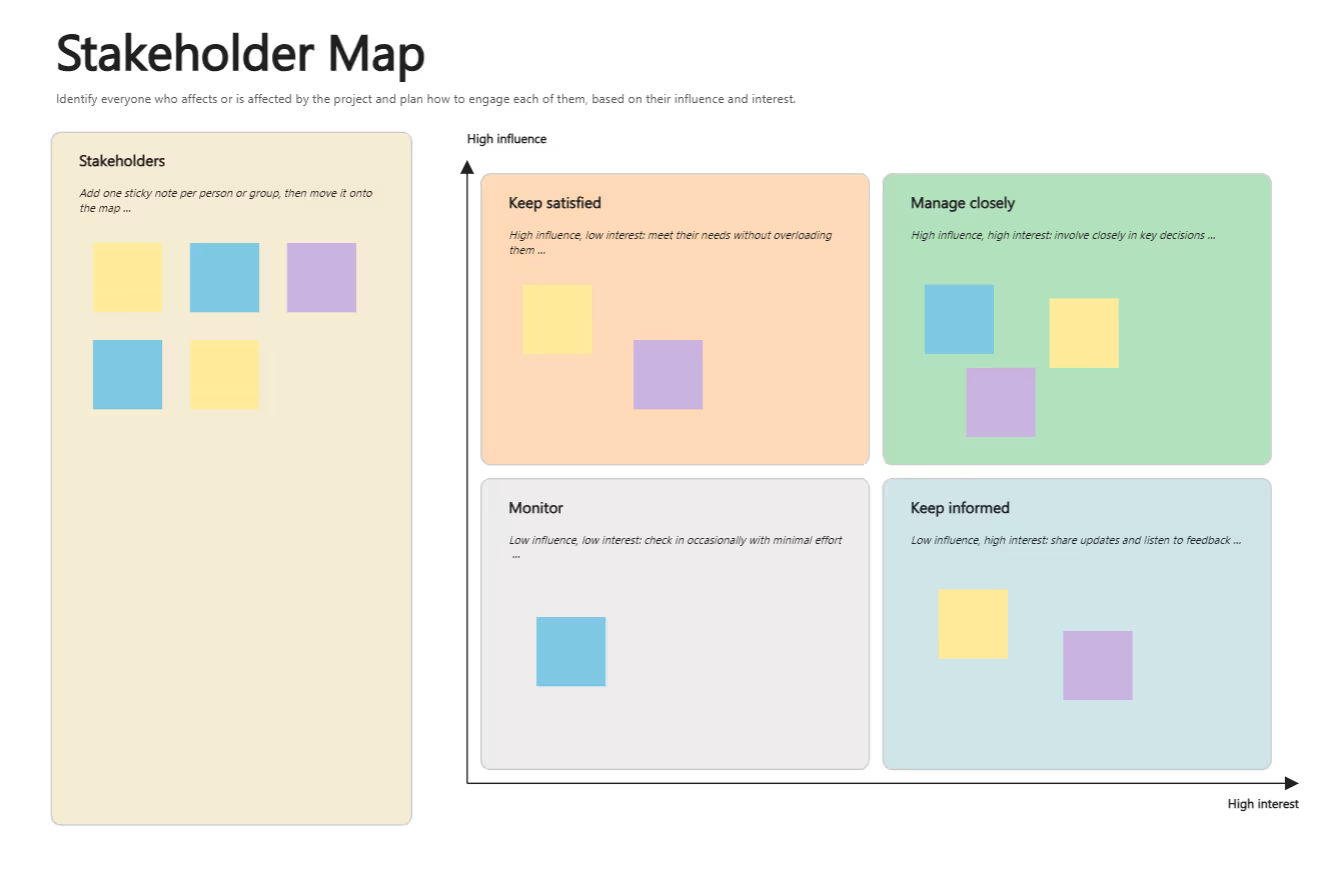
A stakeholder map in the form of a matrix has different quadrants, depending on how its axes are defined. The two most common axes are the stakeholders' "influence" and "interest". This setup results in four quadrants:
- High influence, high interest (top priority): This quadrant contains stakeholders who have a strong influence on the project and a strong interest in it. They are very important because they can significantly shape how the project develops. Keep them well informed and win their support.
- High influence, low interest (keep informed): These stakeholders have a lot of influence but little interest in the project. You should still keep them up to date to avoid unexpected conflicts or resistance. Because of their influence, their opinion may change later on.
- Low influence, high interest (increase engagement): This quadrant contains stakeholders who have little influence on the project but are very interested in it. It is worth engaging them, as they can become enthusiastic supporters.
- Low influence, low interest (minimal attention): These stakeholders have little influence and little interest in the project. They usually need less attention unless there are specific reasons to engage with them.
Tips for creating stakeholder maps
Here are the most important tips for creating a stakeholder map:
- Thorough stakeholder analysis: Before you create the stakeholder map, analyze your stakeholders thoroughly. Identify all relevant parties, their roles, interests, expectations, areas of influence and relationships with each other. The more accurate your information, the more precise your stakeholder map will be.
- Clear criteria for the axes and the resulting categories: Choose the criteria for the axes of your stakeholder map carefully. The most common axes are "influence" and "interest". Make sure these criteria suit the nature of your project and capture the relevant aspects of your stakeholder relationships.
- Clear layout: A clear and visually appealing stakeholder map makes the information easier to understand and interpret. Use colors, symbols or different sizes to show differences in influence and interest. A clear layout makes it easier for everyone involved to work with the map. Focus on the most important stakeholders only. Too many stakeholders, especially irrelevant ones, quickly make a map hard to read.
- Regular updates: A stakeholder map is not a static tool. Projects and organizations evolve, new stakeholders appear and existing ones become irrelevant. Plan regular updates so the map stays current. This lets you react to changes in the stakeholder landscape and adjust your strategies accordingly.
The benefits of a stakeholder map
A stakeholder map offers many benefits in project management and strategic decision-making, and it can be used in any industry. The most important benefits are:
- A clearer picture of the stakeholder landscape: A stakeholder map helps you identify all relevant players and understand their roles, interests and relationships with each other. This gives you a more complete picture of everyone involved and how they can influence the project or initiative.
- Efficient use of resources: By grouping stakeholders into categories (for example by influence and interest), you can decide more easily where to invest your limited resources. This helps you focus your time and energy on the most relevant stakeholders.
- Identifying alliances and conflicts: A stakeholder map shows which stakeholder groups are likely to interact positively or negatively with each other. This lets you make strategic use of emerging alliances and spot and address potential conflicts early.
- Better communication strategies: A well-designed stakeholder map shows which stakeholder groups need to be informed and involved more or less closely. This makes it easier to develop tailored communication strategies, share relevant information with the right people and win stakeholder support.
- Better risk management: By identifying stakeholders who might react negatively to the project or initiative, you can recognize risks early and take action to minimize potential resistance or obstacles.
The best stakeholder mapping tools
If you want to create a stakeholder map online, a suitable tool makes the job much easier. Here are the best-known stakeholder mapping tools, along with their pros and cons.
PowerPoint
PowerPoint is only partly suitable for creating stakeholder maps, as it is a presentation program mainly used for slide presentations. It offers a wide range of shapes, lines and text boxes that you can use to build a stakeholder map.
PowerPoint's advantages are that it is widely available and well known. Its interface is not perfectly user-friendly, but it is familiar, so even non-designers can create diagrams and stakeholder maps.
One drawback is that it has no dedicated features for stakeholder maps, which can make creating complex diagrams time-consuming and cumbersome. It also lacks collaboration features that would be useful for stakeholder mapping in team projects. Another drawback is that PowerPoint is a paid tool.
Freeform
Apple's Freeform is a digital canvas app that works well for stakeholder maps thanks to its flexible and intuitive interface. You can draw freely on a digital canvas and move and adjust objects, which is ideal for visual representations like stakeholder maps.
One advantage is its seamless integration into the Apple ecosystem, which makes it easy to collaborate and share data across Apple devices. However, it is only available on Apple devices, which limits access for users of other operating systems. There are also hardly any ready-made stakeholder map templates.
Paint
Paint is only of very limited use for creating stakeholder maps. It is designed mainly for simple drawings and image editing. Its advantages are its simplicity and the fact that it is available on every Windows system, so it is quick to access and easy to use.
The big drawback is the lack of features for more complex diagrams and the limited tools for editing and placing text, which stakeholder maps require. It also lacks the collaboration features and extensions found in more professional tools.
Collaboard
Collaboard is an online whiteboard that is very well suited to creating stakeholder maps, as it was built specifically for real-time collaboration. It offers a wide range of drawing tools, shapes and text options that are ideal for creating and adjusting stakeholder maps.
A major advantage is that several people can work on the same map at the same time, which makes collaboration and sharing ideas easier. Saved boards are also accessible anytime and from anywhere.
Collaboard: stakeholder map templates
Collaboard makes it easy to create, edit and share your stakeholder matrix online. It is also a good choice for beginners because there are free templates you can use. Even with the free plan, you get access to Collaboard's stakeholder map template. With an upgrade, you can also access many more stakeholder map templates from the Collaboard community.
Here are a few more reasons why Collaboard works well for stakeholder analysis:
- Real-time collaboration: Work on the stakeholder map with several people at the same time, wherever they are. Real-time collaboration makes it easier to exchange ideas and information while you analyze stakeholders and build the map together.
- Visual representation: With Collaboard, you can visualize the information on your stakeholder map right away and present it clearly. This is often easier to read on an online whiteboard than in a spreadsheet. Elements such as cards, shapes, icons and connectors help you create clear and appealing stakeholder maps.
- Easy to adjust: You can change your stakeholder map quickly and easily. New stakeholders, information and relationships are added in no time, without having to rebuild the whole map. This is useful because stakeholders and their relationships often change during a project.
- Strong data protection: Stakeholder analyses often contain sensitive information. Collaboard offers a very high level of data protection and complies with regulations such as the GDPR.
Conclusion: stakeholder maps are essential for stakeholder management
A stakeholder map is a visual representation of the different interest groups that influence a project. Stakeholders are grouped by whether they support the project, are neutral or oppose it. The map is usually created before the project starts and helps you plan efficiently and manage stakeholder interests.
Stakeholder mapping gives you a clear understanding of the relevant interest groups and their influence. It helps you spot potential risks and conflicts early and makes your communication more targeted. This way, decisions are made with all interests in mind, which improves your project's chances of success.
Collaboard is a great tool for creating stakeholder maps quickly and easily. With its intuitive interface and stakeholder map templates, you can move your stakeholder management from paper to an online whiteboard in just a few minutes.
On This Page
Turn this use case into your own whiteboard
Create a free Collaboard account and start working visually with your team today.
No credit card required
Stakeholder map - Frequently asked questions & answers
Do you have any questions? We're here to help.
Stakeholder management is the process of identifying, analyzing and systematically influencing the interests and expectations of groups of people affected by a project. It aims to gain stakeholder support and minimize conflicts.
A stakeholder map is a strategic tool for identifying and analyzing all interest groups in a project. Based on the stakeholder map, strategies and concrete actions can be derived to address the interests of the various stakeholders.
You can create a stakeholder map on a sheet of paper, on a physical whiteboard or using a stakeholder map tool like Collaboard. The steps are the same in each case: 1. Identify the stakeholders 2. Analyze the stakeholders and their interests 3. Visualize the relationships between the stakeholders 4. Conduct the stakeholder analysis to classify stakeholders into different groups 5. Derive strategies and actions based on the analysis.
Online whiteboards such as Collaboard have proven particularly effective for stakeholder maps. These stakeholder mapping tools make it possible to store and visualize all relevant information in one place and can be dynamically adapted over the course of a project.
There are numerous examples of applications for stakeholder maps. They are useful in IT projects in companies, in environmental protection initiatives, for product launches, in political election campaigns and even in small and large school projects.
A stakeholder map can be a network diagram that visualizes the various actors and their relationships with each other. Alternatively, stakeholders can be placed in different quadrants to classify their influence and interest in the project.
Start your next whiteboard now
Get a free trial of Collaboard with up to 3 boards and five people per session. All key features are available for you to try out.