Customer Journey Map: Step-by-Step Guide, Examples and Tools
The customer is king. Customer centricity is firmly embedded in the marketing and business strategies of many modern companies. That makes it even more frustrating when customers repeatedly drop off at specific points in their journey.
In reality, your customers’ journey is often more complex and less linear than it may appear at first glance. A clear overview and a deep understanding of the customer journey help you improve your marketing strategies, identify friction points and increase customer satisfaction.
In this guide, we show you how to create a Customer Journey Map and use it effectively to better understand, engage and retain your customers. From the basic steps to practical Customer Journey Map examples, tools and templates, you will learn everything you need to know about customer journey mapping.
Want to start creating your Customer Journey Map right away?
What is a Customer Journey Map?
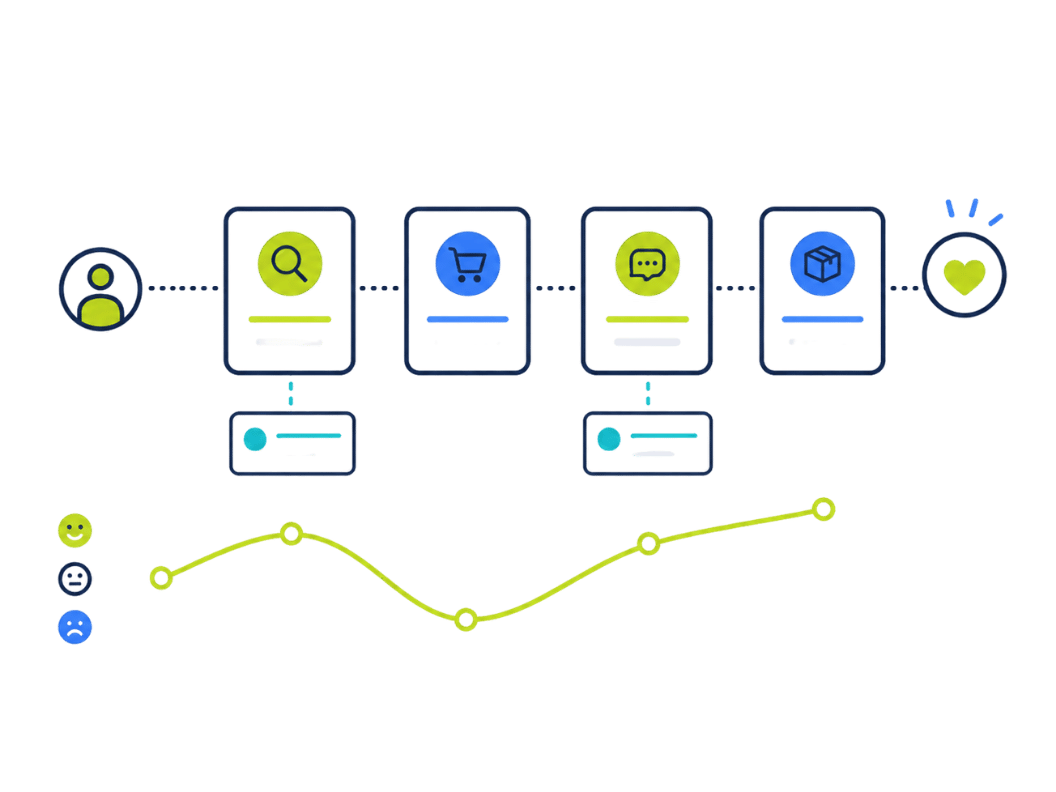
A Customer Journey Map is a visual tool that illustrates the entire experience a customer has with your company. It shows all the touchpoints a customer goes through, from the first interaction to follow-up and long-term support.
The goal of a Customer Journey Map is to understand customers’ needs, expectations and emotions, and to optimize every interaction in order to create a better customer experience.
Why is Customer Journey Mapping important?
Customer Journey Mapping is important because it helps you see your company from the customer’s perspective and improve the overall customer experience. By identifying pain points and bottlenecks in the customer journey, you can make targeted improvements that increase customer satisfaction and strengthen customer loyalty.
A well-structured Customer Journey Map also provides valuable insights that help you develop more effective marketing strategies and contribute to long-term business success.
The phases of a Customer Journey Map
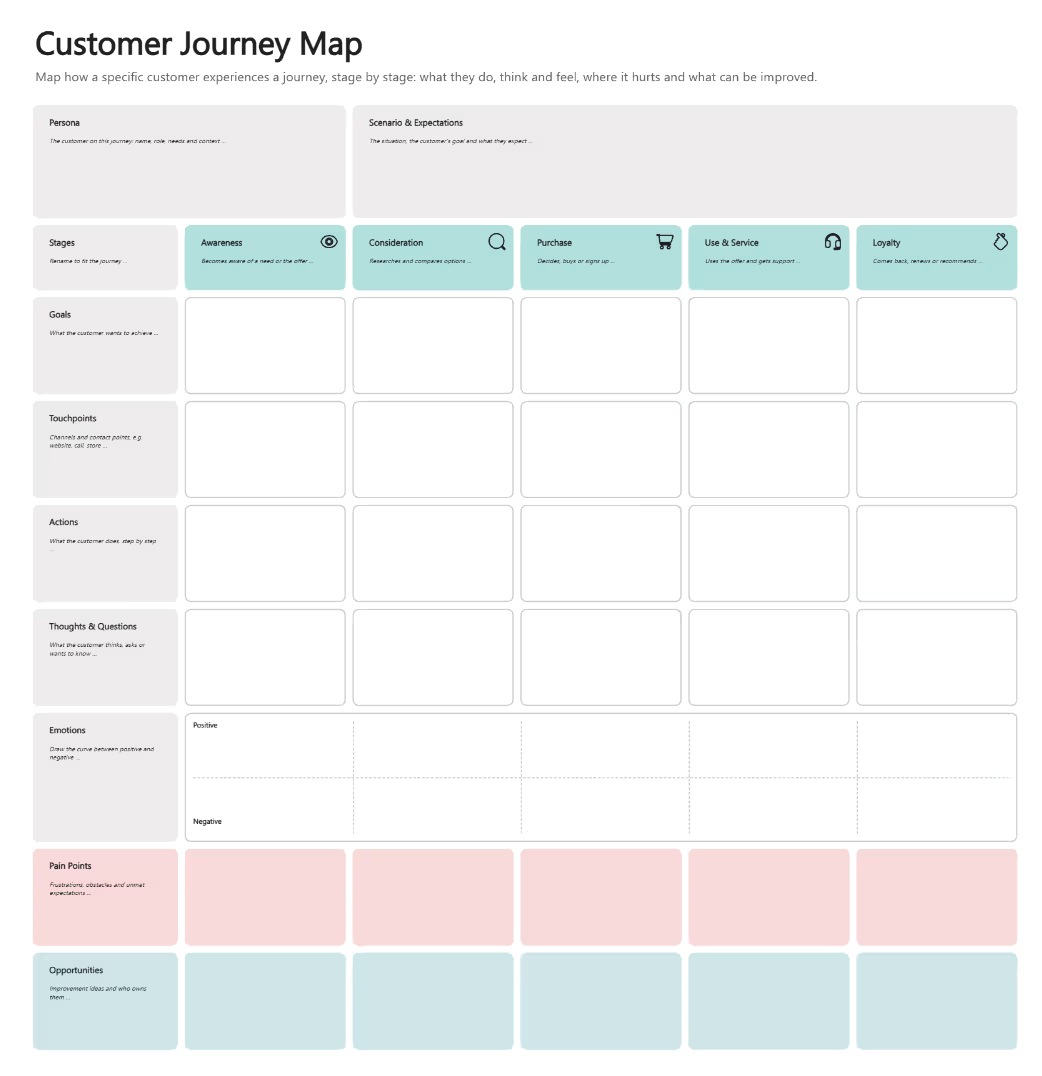
A classic customer journey usually includes the phases Awareness, Consideration, Conversion/Purchase, Retention and Advocacy. These phases provide a basic structure for analyzing the customer journey.
However, no two companies are the same, and customer journeys can vary significantly depending on the product or service. Here is an overview of the five phases:
- Awareness: Which channels make potential customers aware of your brand? Use analytics to identify the most effective channels.
- Consideration: What influences your customers’ decision-making process? Make sure your touchpoints support customers as they evaluate their options.
- Conversion/Purchase: What obstacles occur during the buying process? Tools like Collaboard can help you visualize and resolve these bottlenecks.
- Retention: How do you stay in touch with your customers? Plan targeted follow-up actions based on the insights from your map.
- Advocacy: Use satisfied customers to generate recommendations and referrals.
It is often worth rethinking classic customer journey models, as every company interacts with its customers in a different way. The customer journey for buying toothpaste is very different from the journey of a company purchasing new software.
That is why it makes sense to adapt the classic approach to your company, your customers and your specific business context.
What are the benefits of Customer Journey Mapping?
Customer Journey Mapping is valuable because it helps you take the customer’s perspective and improve the entire customer experience. By identifying weaknesses, bottlenecks and pain points along the customer journey, you can make targeted improvements that increase customer satisfaction and strengthen customer loyalty.
A Customer Journey Map offers many benefits for optimizing customer relationships and internal processes:
- Improved customer perspective: Understand your customers’ needs, expectations and motivations by analyzing the entire customer journey from their point of view.
- Identification of pain points: Discover bottlenecks or friction points that negatively affect the customer experience and optimize them in a targeted way.
- More effective marketing strategies: Use the insights from your Customer Journey Map to align your marketing activities more closely with your customers’ needs.
- Higher customer satisfaction and loyalty: By improving key touchpoints, you can create better experiences and build long-term relationships with your customers.
- Better team collaboration: With digital tools like Collaboard, teams can work on a Customer Journey Map together in real time, make changes and add comments directly.
The classic Customer Journey Map
A classic Customer Journey Map usually consists of five phases: Awareness, Consideration, Conversion/Purchase, Retention and Advocacy.
However, it is often worth rethinking classic customer journey models, as every company interacts with its customers in a different way. The customer journey for buying toothpaste is very different from the journey of a company purchasing new software.
That is why it makes sense to adapt the classic approach to your company, your customers and your specific business context.
Steps to create a Customer Journey Map
A Customer Journey Map should be tailored specifically to your company. It is important to think through every step carefully in order to create a complete and accurate picture of your customers’ journey. Below, we explain the key steps you should follow to create an effective Customer Journey Map.
Step 1: Define your goals
The first step in creating a Customer Journey Map is to define clear goals. Think about what you want to achieve with the mapping process. Do you want to better understand how customers interact with your company, optimize specific touchpoints or identify weaknesses in the customer journey?
A clear goal helps you stay focused and collect the right data.
Tip: Define measurable goals so you can evaluate success later, for example using the SMART criteria: Specific, Measurable, Achievable, Relevant and Time-bound.
Step 2: Analyze your target audience
To create a successful Customer Journey Map, you need to understand your target audience in detail. Analyze demographic data, behavior patterns and customer needs. This helps you better understand their expectations and make realistic assumptions for your map.
Key steps include:
- Collect data from surveys, interviews or existing CRM systems.
- Analyze recurring patterns in customer interactions.
- Define the main needs and pain points of your target groups.
Step 3: Create personas
Based on your target audience analysis, create detailed personas. Each persona should be a fictional but realistic representation of a customer type, including a name, background information, goals and pain points.
These personas form the basis for understanding different customer segments and their individual customer journeys.
Tip: Create a visual representation for each persona on an online whiteboard such as Collaboard. This makes it easier to discuss the data with your team. You can also use persona templates to structure this step more efficiently.
Step 4: Identify the touchpoints for your Customer Journey Map
Next, identify the touchpoints where customers interact with your company. These can be physical touchpoints, such as a visit to a store, or digital touchpoints, such as website visits, emails or social media interactions.
The more precisely you define these touchpoints, the better you can map the customer journey.
Important touchpoint categories include:
- Before the purchase: Website visits, advertisements, social media, search engines or recommendations.
- During the purchase: Online checkout, sales conversations, customer service or payment processes.
- After the purchase: Emails, support, onboarding, loyalty programs or follow-up communication.
Step 5: Map the customer journey
In this step, you visualize the entire customer journey. Map the path your customers take through the different phases, from initial awareness and decision-making to purchase and post-purchase support.
Use a suitable tool such as Collaboard to display the individual touchpoints and interactions on an infinite digital whiteboard.
Collaboard allows you to integrate different files and data formats and present the customer journey in a clear, visual way.
You can structure the phases as follows:
- Awareness: How do customers become aware of your offer?
- Consideration: What information do they look for before making a decision?
- Purchase: What supports or prevents the final conversion?
- Post-purchase: Which actions help strengthen customer loyalty?
Step 6: Analyze and optimize the journey
The final step is to analyze your Customer Journey Map. Identify where customers encounter problems and uncover opportunities for improvement.
Ask yourself how you can improve the customer experience at each individual touchpoint. Use the insights from your map to define targeted measures and increase customer satisfaction in the long term.
Tip: Use direct feedback from surveys or customer interviews to make focused improvements. With Collaboard, you can visualize these insights in real time and plan concrete actions together with your team.
Visualization techniques for Customer Journey Maps: Examples
To truly understand the customer journey, a clear and precise visualization is essential. A well-designed Customer Journey Map helps you present complex processes and interactions in a structured way, making it easier to identify opportunities for improving the customer experience.
In this section, you will learn how to visualize and analyze the customer journey effectively.
There are several ways to represent a Customer Journey Map visually. Here are some common examples:
- Linear timelines: This method is ideal for showing the chronological sequence of touchpoints. It clearly illustrates how customers move from one phase of the journey to the next.
- Circular diagrams: This type of visualization highlights the cyclical nature of many customer journeys and shows how customers may interact with your company repeatedly over time.
- Swimlane diagrams: Swimlane diagrams display the interactions of different customer segments or personas in parallel. This makes it easier to identify similarities, differences and specific needs across customer groups.
- Heatmaps: Heatmaps show which touchpoints are used most frequently or where customers encounter difficulties. They are especially useful for identifying friction points and prioritizing improvements.
With Collaboard, you can use all of these visualization techniques to create a detailed and engaging Customer Journey Map. The platform provides an infinite digital whiteboard where you can integrate diagrams, files and data to build a complete picture of the customer journey.
Tools and resources for Customer Journey Mapping
An effective Customer Journey Map requires not only careful planning and analysis, but also the right tools. Software tools offer many advantages that can make the process easier, faster and more effective. They help you visualize the customer journey, improve collaboration and gain valuable insights into the customer experience.
What are the benefits of digital Customer Journey Mapping tools?
Digital tools for creating Customer Journey Maps offer companies a wide range of benefits. They make it easier to visualize complex customer journeys and gain valuable insights into touchpoints, bottlenecks and opportunities for improvement.
Diagrams, timelines and mind maps help teams structure and analyze every phase of the customer journey. Key benefits include:
- Clarity and structure: Visualizations make complex data easier to understand and help create a shared understanding across the team.
- Real-time collaboration: Teams can work on the same map at the same time, exchange ideas and make changes directly. With Collaboard, this interactive way of working is supported by a flexible digital whiteboard.
- Integration with business systems: Tools like Collaboard can be connected with CRM, project management or analytics software, helping you use data more effectively and improve decision-making.
Another important advantage of many digital tools is the ability to customize your map. Templates, color schemes and flexible visualization options help you adapt the tool to your specific needs and workflows.
Data security is also essential. Tools like Collaboard offer flexible hosting options, either on-premises or in the cloud, and are designed to meet high security standards. This helps ensure that sensitive customer data can be processed in a GDPR-compliant way.
Turn your Customer Journey Map into a valuable tool for your strategy. Try Collaboard for free and benefit from an intuitive platform for effective teamwork and in-depth analysis.
Free Customer Journey Map template from Collaboard
With Collaboard’s free Customer Journey Map template, you can visualize the entire journey of your customers. From the first interaction to long-term customer loyalty, the template gives you a clear overview of touchpoints, challenges and opportunities for improvement.
You can customize every step, add notes and use color coding to highlight important details.
The benefits of the template include:
- Real-time collaboration: Work on the Customer Journey Map together with your team.
- Flexible customization: Adapt the template to your company, customers and processes.
- Integration: Synchronize data with other tools, such as CRM systems.
Collaboard enables you to host the template securely, either on-premises or in the cloud of your choice. Get started for free and optimize your customer journey.
Create Customer Journey Maps with AI
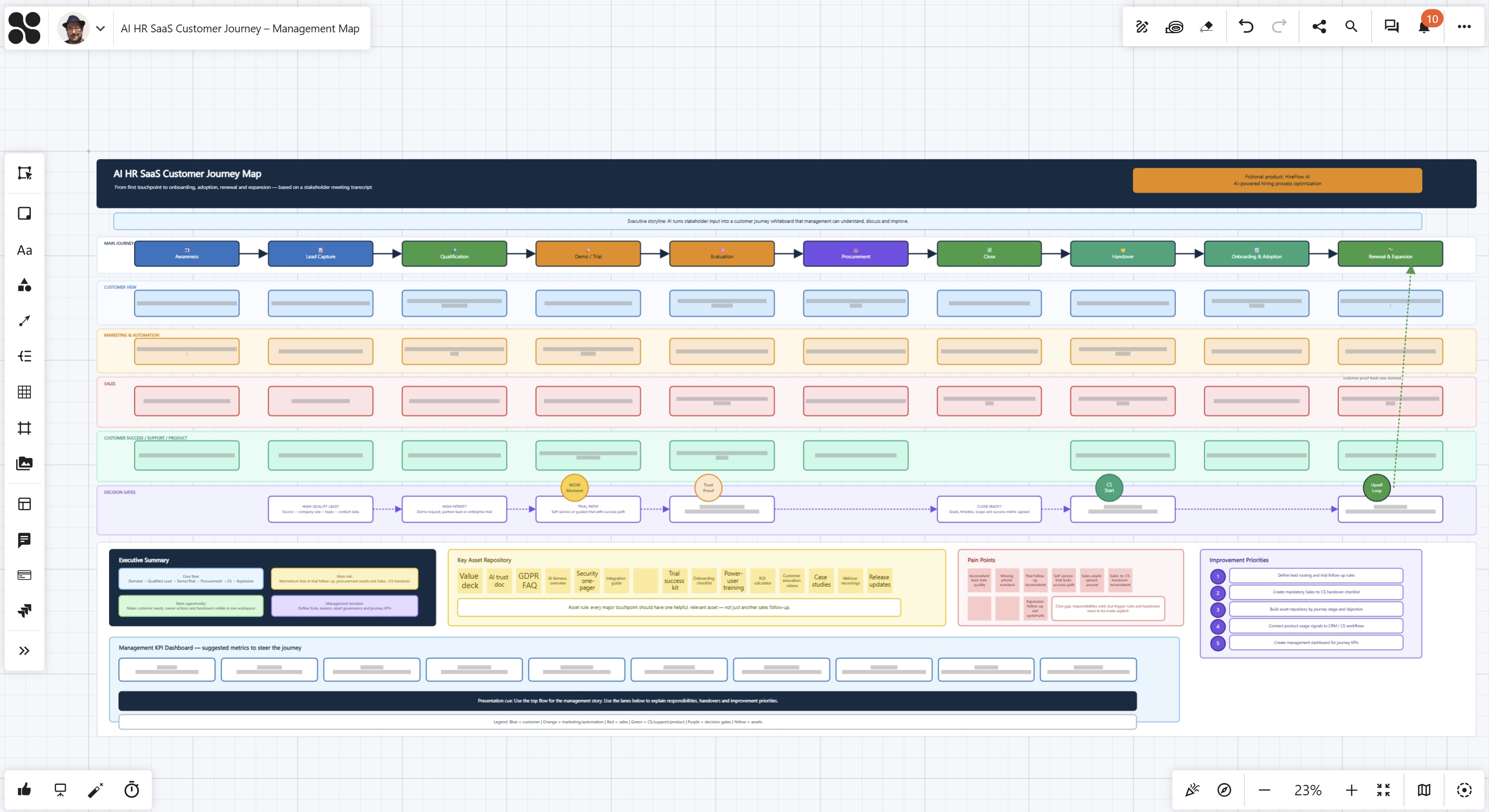
With the Collaboard MCP Server, you can also use AI to generate Customer Journey Maps faster. Instead of starting from a blank canvas, you can describe your target audience, customer touchpoints, pain points or business context in a prompt, and AI can help create a structured first version directly on the whiteboard.
This gives your team a strong starting point for discussion, refinement and optimization. You can then adapt the map together, add insights from customer interviews or CRM data, and turn the AI-generated structure into a practical tool for improving the customer experience. Read here how to create an AI-generated customer journey map.
Customer Journey Mapping: Understand your customers better
With a clearly structured Customer Journey Map, you can analyze your customers’ journey in detail and improve it in a targeted way. By identifying weaknesses, optimizing customer journey touchpoints and taking the customer’s perspective, you can increase customer satisfaction and improve the efficiency of your internal processes.
Tools like Collaboard help you create Customer Journey Maps visually and interactively, making collaboration across teams much easier.
Start creating your own Customer Journey Map today and benefit from the possibilities offered by digital tools. Try Collaboard for free and discover how easy it is to sustainably improve your customer experience.
On This Page
Turn this use case into your own whiteboard
Create a free Collaboard account and start working visually with your team today.
No credit card required
Customer Journey Map: Frequently Asked Questions and Answers
Do you have any questions? We're here to help.
A customer journey map is a visual tool that displays all touchpoints a customer has with a company – from the first interaction to after-sales support.
Customer feedback provides valuable insights into the actual experiences and needs of customers and helps to design the customer journey in a realistic and effective way.
The steps include goal setting and definition, target audience analysis, creation of personas, identification of touchpoints, mapping the customer journey and subsequent analysis and optimization.
Tools such as Collaboard, which offer an infinite digital canvas, real-time collaboration and high data protection standards, are particularly useful.
Collaboard makes it possible to host maps on-premises or in a private cloud, guaranteeing the highest security standards. With options such as Active Directory integration and encryption, sensitive data is protected at all times.
Regular reviews and updates are important to take into account changing customer needs and market conditions.
Analyze all interactions that customers have with your company, including physical and digital touchpoints, to get a complete picture.
Yes, by developing specific personas for each target group, you can create tailored maps. This method helps to better understand and specifically address the different wishes and expectations of each audience.
It helps companies to adopt the customer's perspective, identify weak points and improve the overall customer experience.
A visually presented journey makes complex processes understandable and facilitates teamwork. Customer journey map tools like Collaboard offer interactive whiteboards to flexibly design and adapt the journey.
Start your next whiteboard now
Get a free trial of Collaboard with up to 3 boards and five people per session. All key features are available for you to try out.