8D Report Template
Solve complaints and quality problems systematically in eight disciplines. The 8D report documents every step, from forming the team to the lessons learned.
Free to start · Swiss-made · GDPR compliant
Working through an 8D report on the board
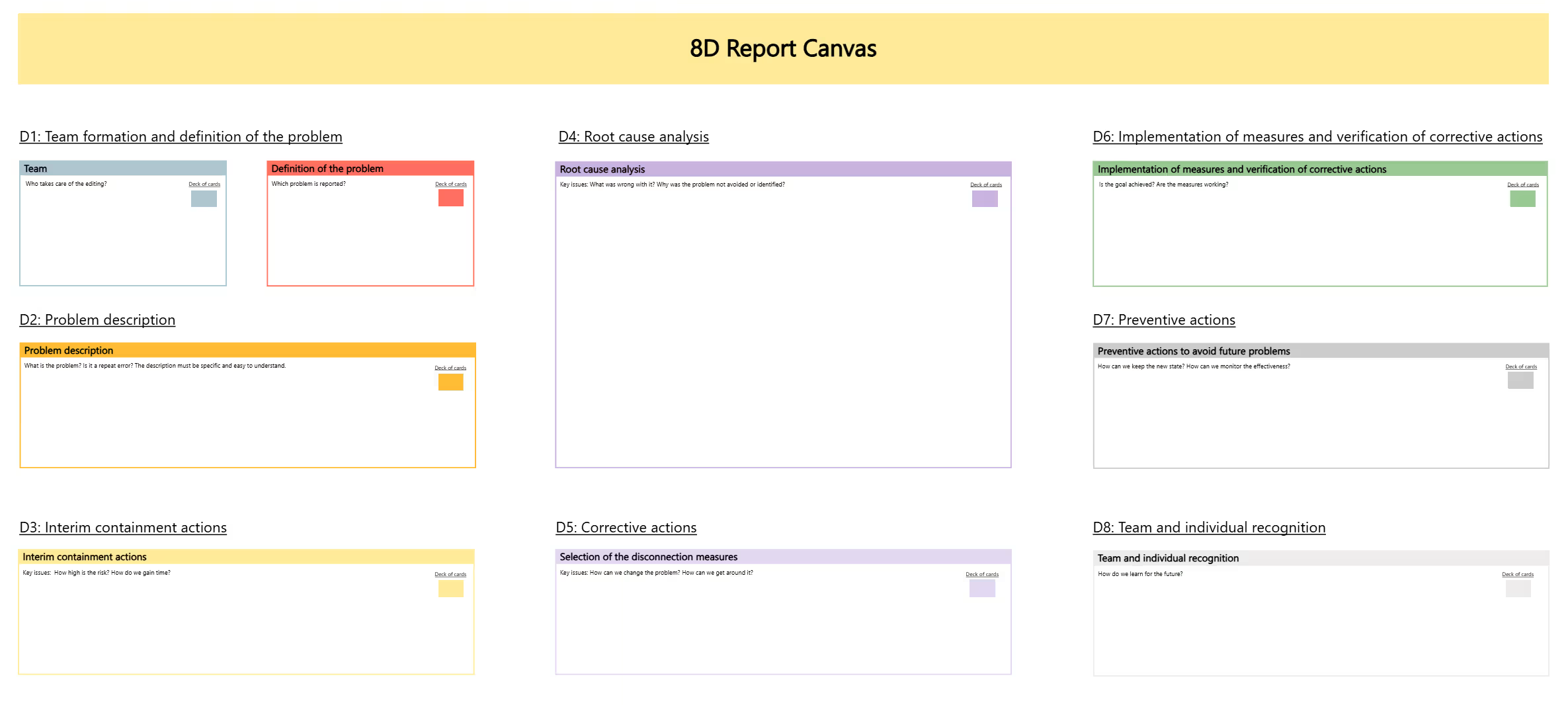
The Collaboard template arranges the eight disciplines in three columns, from D1 Team formation to D8 Team recognition. Each field has its own color, guiding questions and a deck of notes. D4 Root cause analysis has the most space, because that's where most of the work happens.
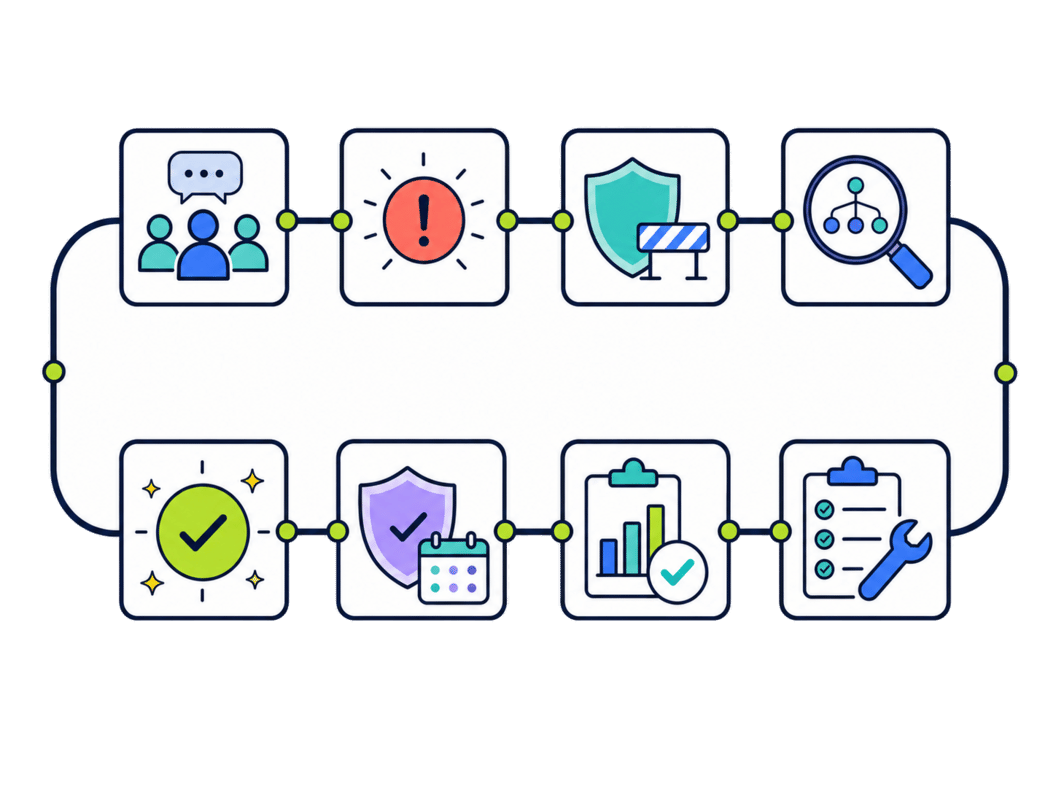
Define team and problem
Fill in D1 and D2: who works on the problem, and what exactly happened?
Contain the damage
In D3, agree on immediate actions that protect the customer while you search for the cause.
Find the root cause
Use D4 to analyze what went wrong and why it wasn't caught, for example with the 5 Whys.
Correct and verify
Select measures in D5 that remove the cause, and check in D6 whether they work.
Prevent recurrence
In D7, define how to keep the new state and how to monitor it.
Close and recognize
Use D8 to record lessons for the future and to thank the team.
What is an 8D report?
The 8D report is a structured method for solving problems in eight disciplines, from forming a team to recognizing its work. It is widely used in the automotive and manufacturing industries to handle complaints and quality problems, and makes sure a problem is contained quickly, its root cause removed and a recurrence prevented.
The eight disciplines of the template
The examples follow one illustrative scenario: a supplier receives a customer complaint about loose screws in a delivered component.
- D1: Team and problem definition Who works on the problem, and which problem was reported? Example: quality, production and the customer's contact person.
- D2: Problem description Specific and easy to understand. Example: 3 percent of the housings from one batch have loose screws.
- D3: Interim containment actions How high is the risk, and how do we gain time? Example: check all stock and ship only inspected parts.
- D4: Root cause analysis What went wrong, and why wasn't it caught? Example: a worn screwdriver bit delivered too little torque.
- D5: Corrective actions How do we remove the cause? Example: replace the bits on a fixed schedule.
- D6: Implementation and verification Is the goal achieved, and do the measures work? Example: no loose screws in the next five batches.
- D7: Preventive actions How do we keep the new state? Example: torque checks added to the daily routine.
- D8: Team recognition What do we learn for the future? Example: share the findings with other lines and thank the team.
For the root cause analysis in D4, the 5 Whys template is a good fit.
Complaints, audits and other 8D cases
- Customer complaints Handle a complaint in a structured way, from containment to prevention.
- Internal quality problems Solve recurring defects for good.
- Supplier management Work through a problem together with a supplier.
- Audits Show auditors how a problem was analyzed and solved.
Containment, verification and documentation
- Separate containment and correction D3 protects the customer now. D5 removes the cause. You need both.
- Describe the problem with facts Numbers, batch, location and time make D2 useful.
- Don't skip verification A corrective action only counts once D6 shows that it works.
- Keep the board as a record The filled-in canvas documents the case for customers and audits.
Why Collaboard
A Swiss-made online whiteboard for teams that care where their data lives.
Your data stays in Europe
Choose hosting in Switzerland, Germany or the EU, fully GDPR compliant. Or run Collaboard on your own servers.
Invite anyone with a link
Guests join your board for free, right in the browser. Nothing to install, no extra licenses for participants.
Made in Switzerland, with real support
Collaboard is developed in Switzerland. When you need help, you talk to people who know the product.
Frequently asked questions
Is the 8D report template free?
Yes, the 8D report template is free to use with a Collaboard account. The free plan includes up to 3 boards and five people per session.
What does 8D stand for in the 8D report?
In the 8D report, 8D stands for eight disciplines, the eight steps of the problem-solving process.
Where is the 8D report used?
The 8D report is used mainly in quality management, especially in the automotive and manufacturing industries.
Which methods work well with the 8D report?
For the root cause analysis in D4 of the 8D report, the Ishikawa diagram and the 5 Whys are common.
Can several people work on an 8D report?
Yes, the whole team can work on an 8D report on the same board in real time.
Start your next whiteboard now
Get a free trial of Collaboard with up to 3 boards and five people per session. All key features are available for you to try out.